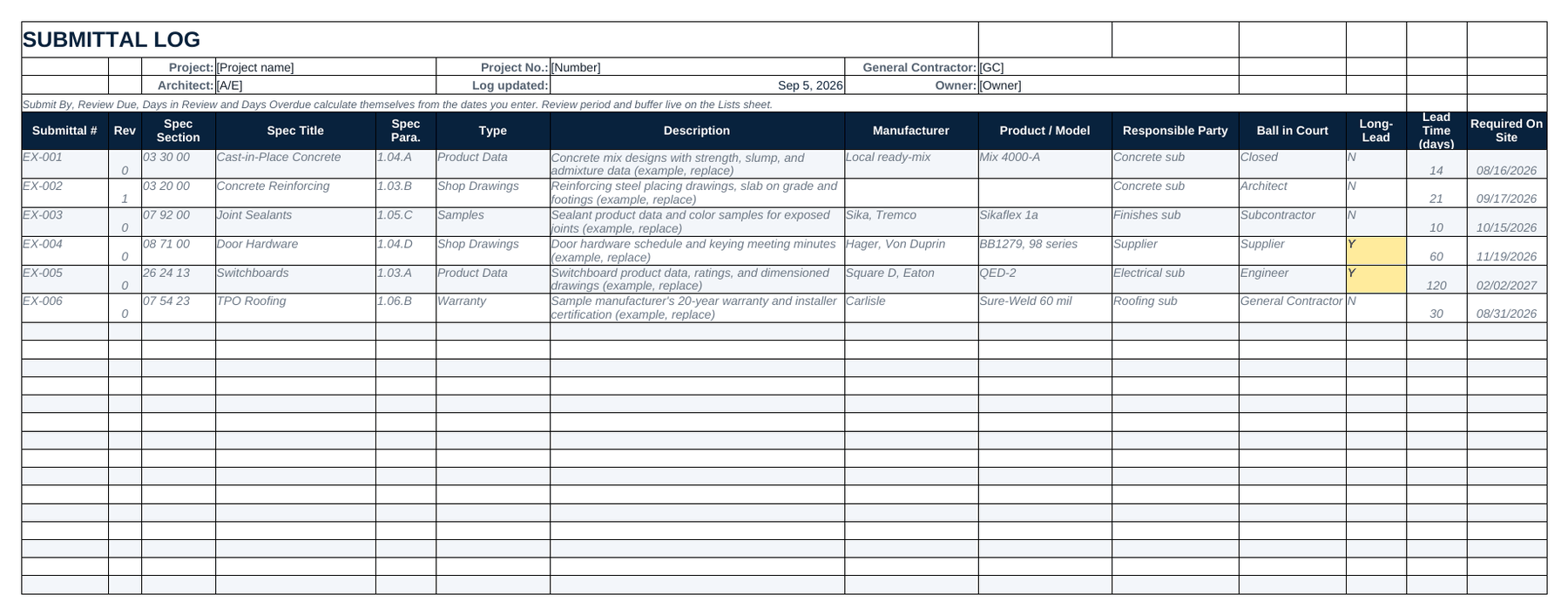
Navy
Ink header, safety orange numbers. The default, and the one in the screenshots below.
 Book a fit call
A submittal log template is a spreadsheet that tracks every submittal a project requires: the spec section it comes from, what has to be submitted, who owes it, and where it stands. Six editions below, screenshots first. No email required.
While it downloads: this log, filled in from your own spec book, is what Build my log returns.
Ink header, safety orange numbers. The default, and the one in the screenshots below.
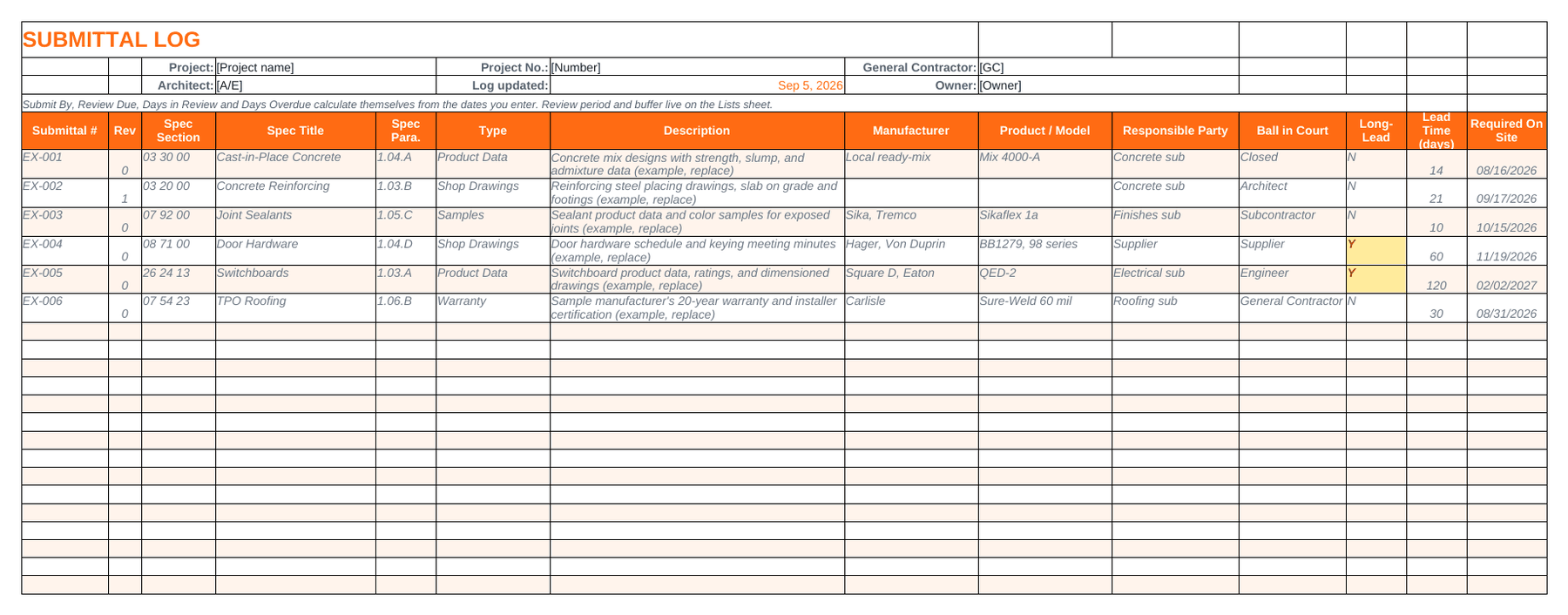
Orange header, navy numbers. Reads from across the trailer.
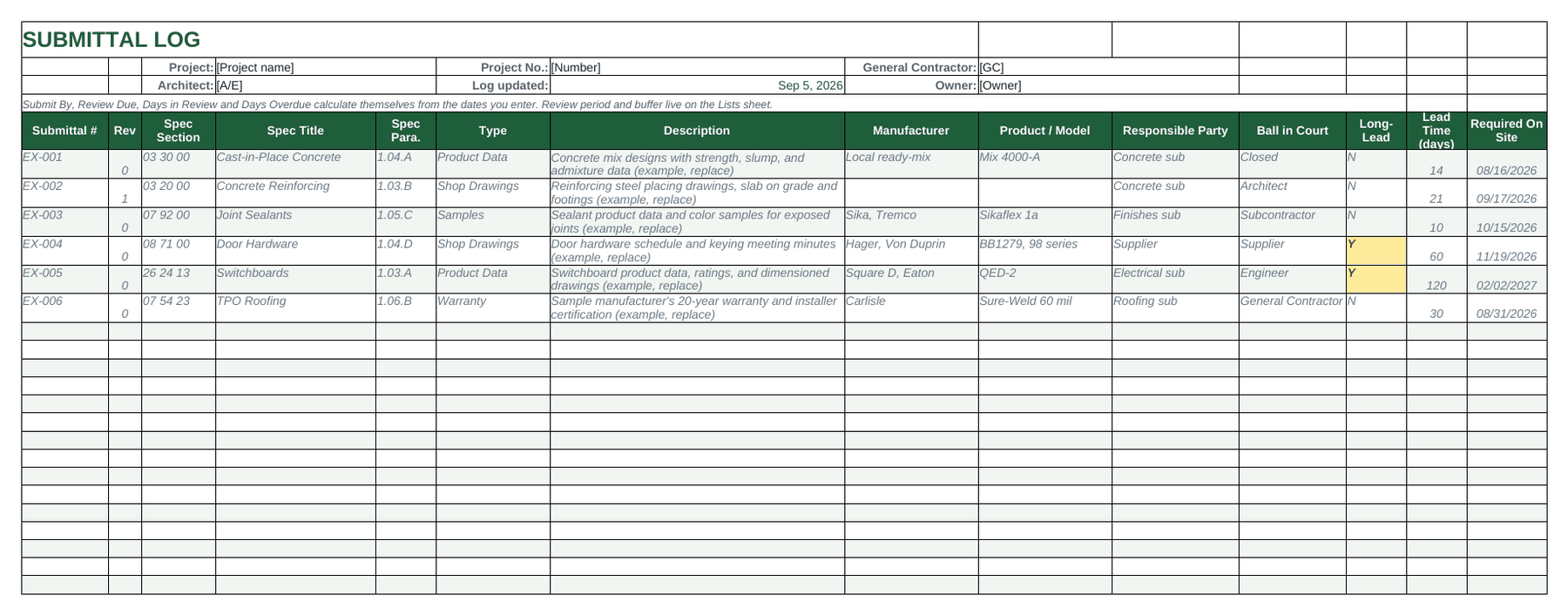
Deep green header, sage accents. Quiet enough to live open all day.
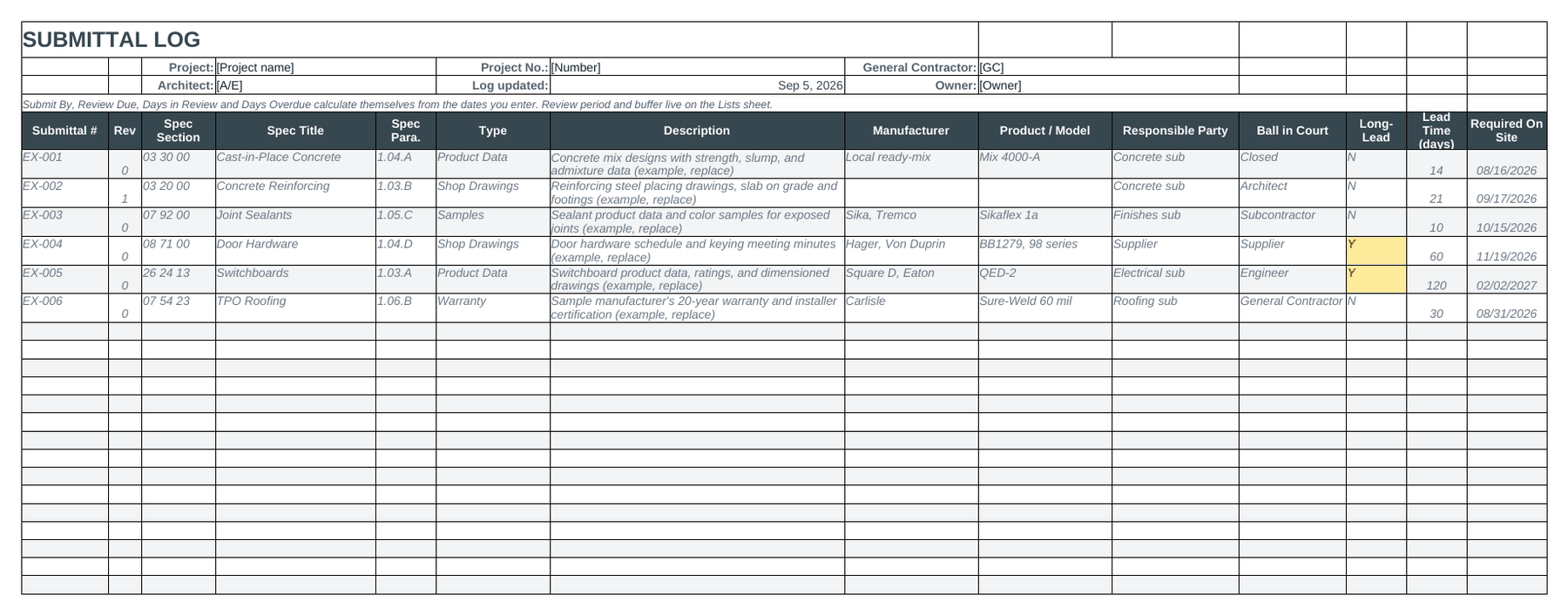
Charcoal header, amber numbers. The one that prints cleanly in gray.
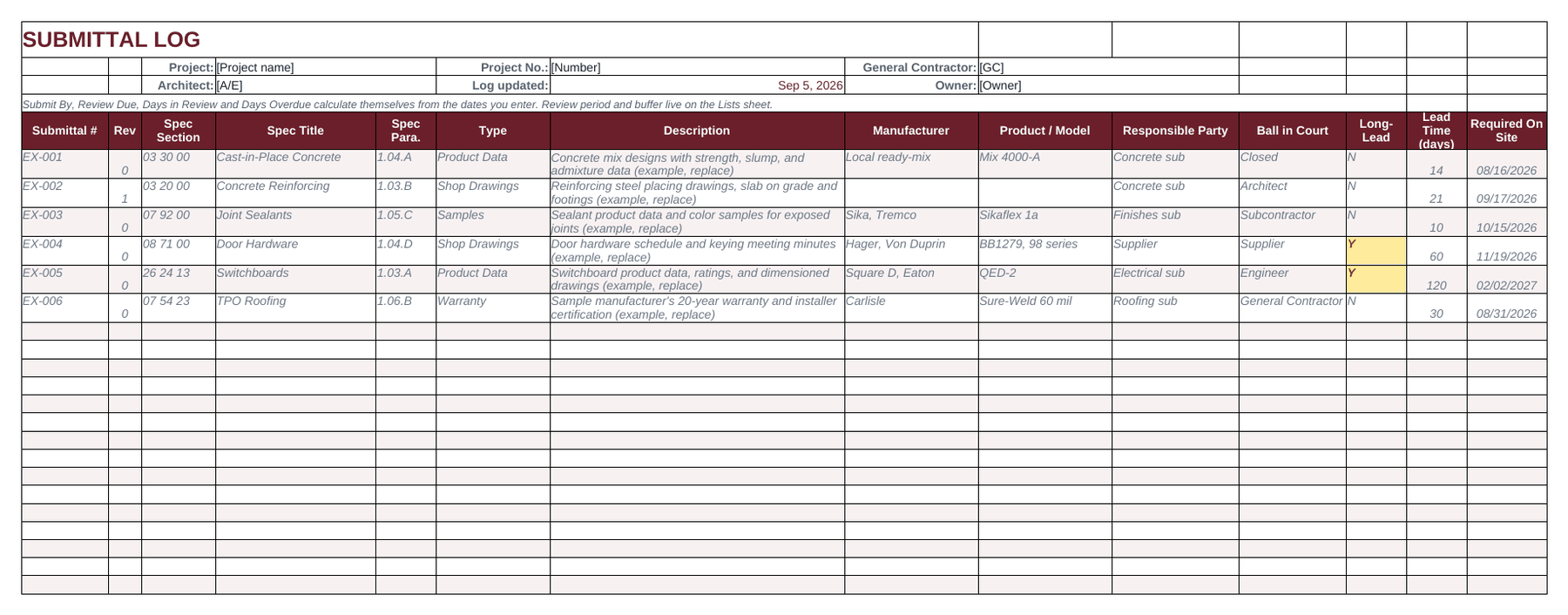
Oxblood header, brass numbers. For the office that already has a color.
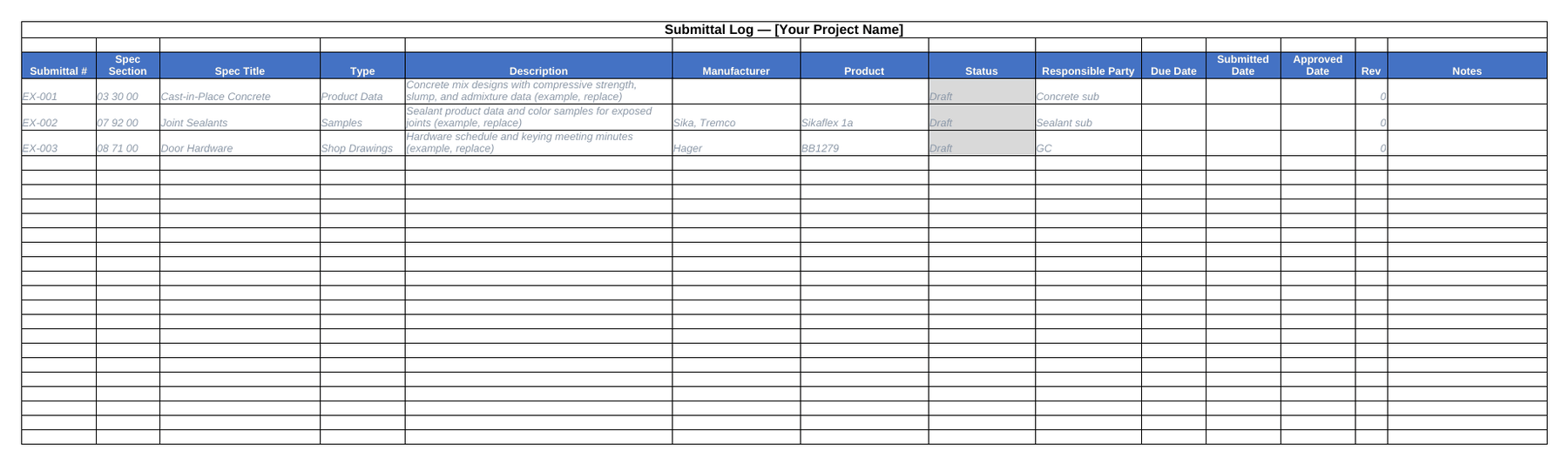
The 14-column log SubPro's own exports use, with dropdowns and a legend sheet. The Log Build returns this format filled in.
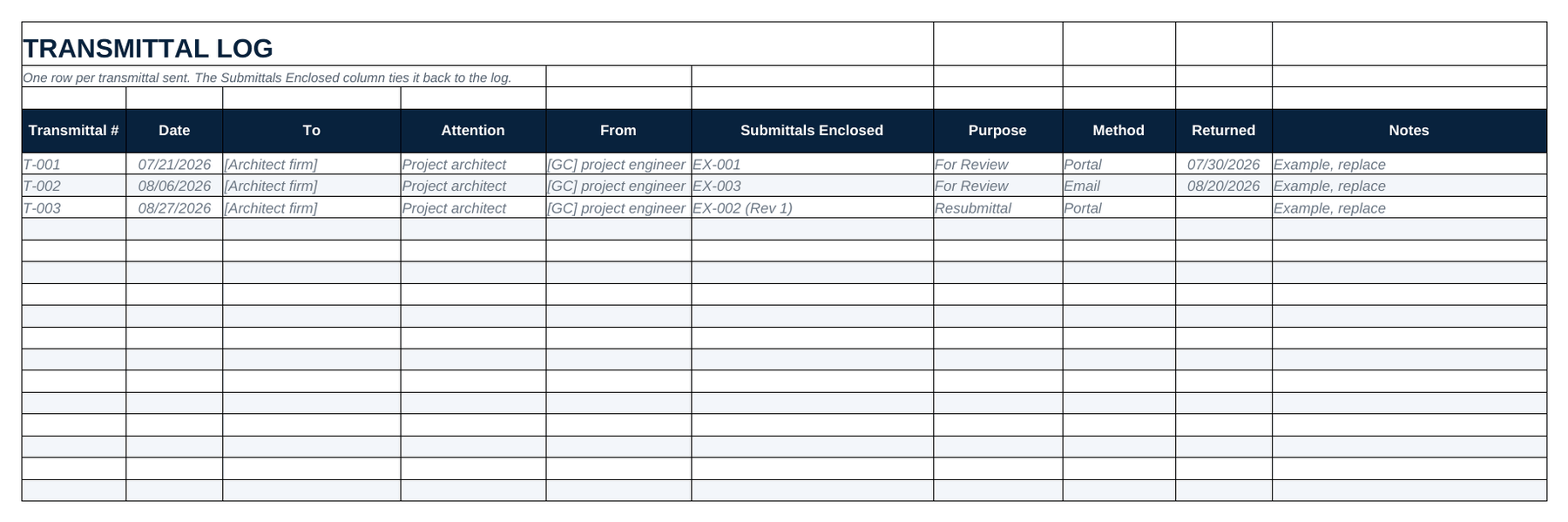
Seven sheets. The four you will live in are below, rendered from the Navy file. The other three are Read Me, Lists, and a note about getting it filled in.
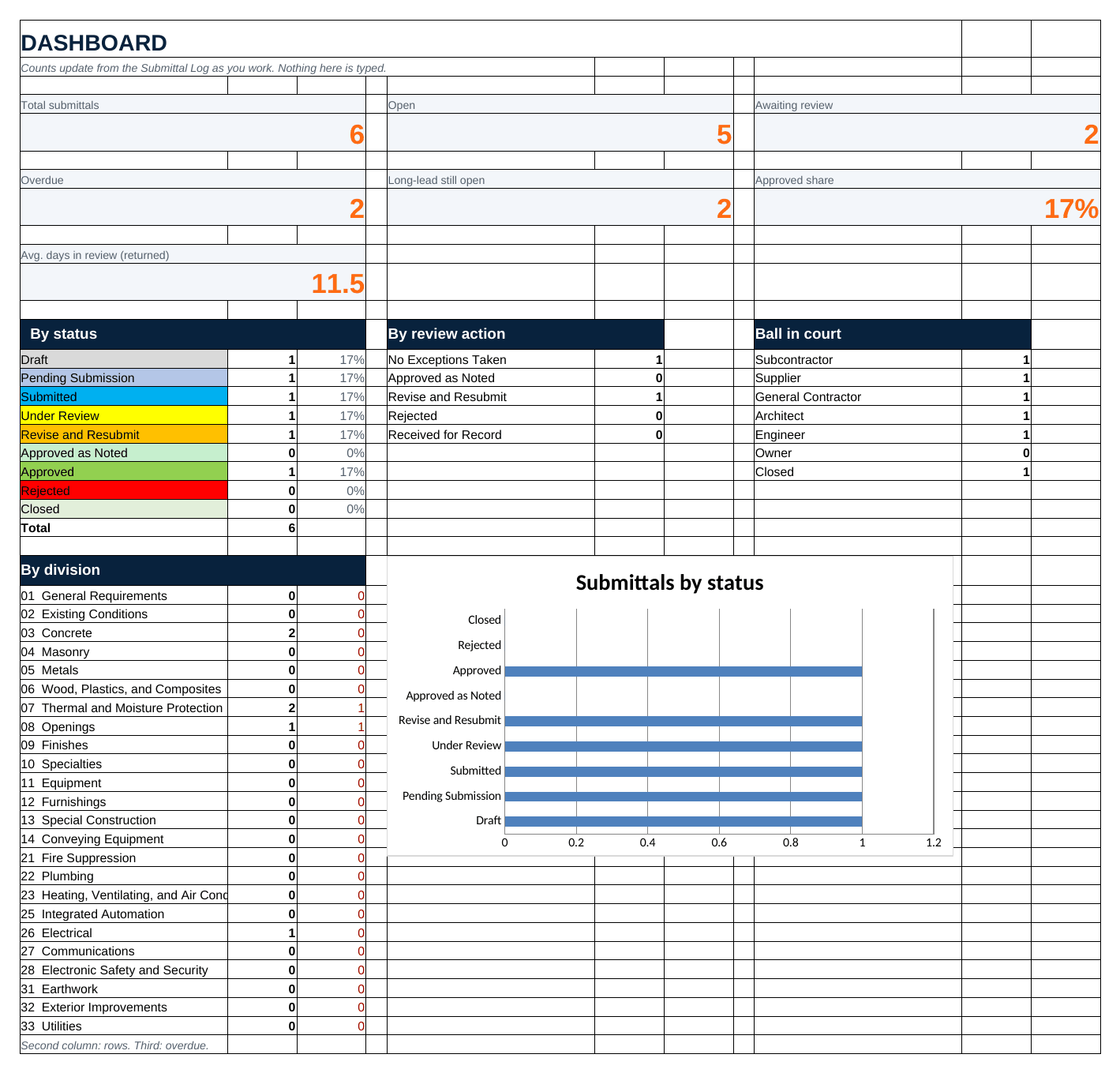
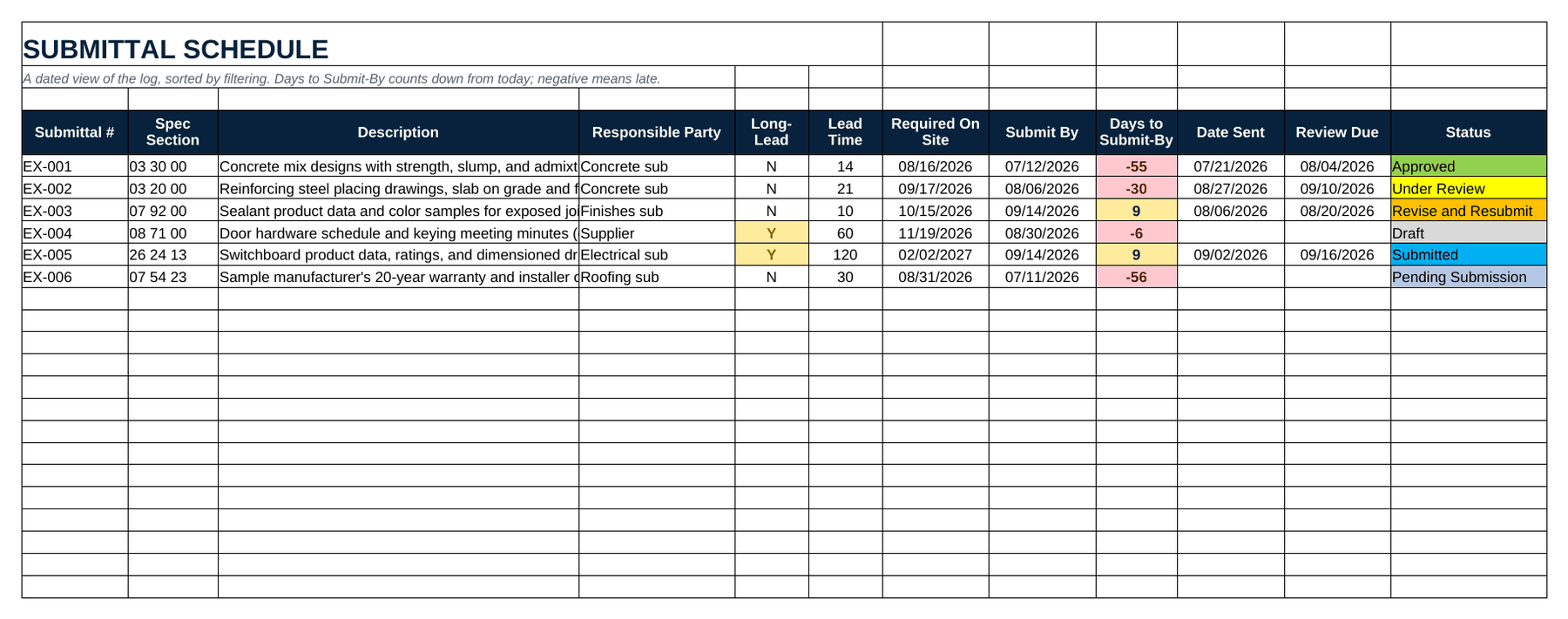
You type two dates and a lead time. The workbook does the arithmetic and turns red when it is losing.
Every column earns its place. Delete one and someone downstream asks you for it by Friday. The Classic log carries the first fourteen of these.
| Column | What goes in it |
|---|---|
| Submittal # | Your numbering under the project, TW 0024-001 and up, never reused. The transmittal and the returned copy quote it. |
| Rev | 0 on first issue. Add one for every resubmittal so the history reads at a glance. |
| Spec Section | The six-digit MasterFormat number with spaces, 08 71 00. The dashboard counts divisions from these first two digits. |
| Spec Title | The section name as the project manual prints it, so a reviewer does not need the number memorized. |
| Spec Para. | The paragraph that requires the item, 1.04.A. The citation that settles arguments. |
| Type | A dropdown of 15 submittal types, each defined on the Read Me sheet. |
| Description | What is being submitted, in one sentence a reviewer can check against the spec book. |
| Manufacturer | The manufacturers the section names, comma separated when it names more than one. |
| Product / Model | Model numbers when the project manual calls them out. |
| Responsible Party | Who owes the submittal. The list is yours to edit on the Lists sheet. |
| Ball in Court | Who holds it right now: subcontractor, supplier, GC, architect, engineer, or owner. |
| Long-Lead | Y turns the cell amber and sorts the row to the top of the schedule view. |
| Lead Time (days) | Order to delivery, from the supplier's quote. |
| Required On Site | The need-by date from the construction schedule. |
| Submit By | Calculated: required on site, less lead time, less the review period, less the buffer. |
| Date Sent | When it went to the design team. Starts the review clock. |
| Review Due | Calculated: date sent plus the review period on the Lists sheet. |
| Date Returned | When the stamp came back. |
| Days in Review | Calculated: returned minus sent, or today minus sent while it is still out. Your reviewer's turnaround record. |
| Review Action | The stamp wording: No Exceptions Taken, Approved as Noted, Revise and Resubmit, Rejected, Received for Record. |
| Status | A dropdown of nine, and the cell colors itself as it changes. |
| Days Overdue | Calculated and red when positive: against Submit By before sending, against Review Due after. |
| Package File | The file name or link for the assembled submittal package. |
| Notes | Substitutions, hold points, owner decisions, and anything the next reviewer needs to know. |
Take joint sealants. The spec book says, in Section 07 92 00 paragraph 1.05.C, that the contractor shall submit product data and color samples for each sealant used in exposed joints. That one sentence becomes one row:
002 | 0 | 07 92 00 | Joint Sealants | 1.05.C | Samples | Sealant product data and color samples for exposed joints | Sika, Tremco | Finishes sub | Subcontractor | N | 10 days | required on site 10/15
The description restates the requirement in plain words. The type column tells a reviewer to expect product data and physical samples. The paragraph points at the exact sentence, so when the architect asks why a color board showed up, the answer is one lookup away. The workbook takes the lead time and the site date and writes the submit-by date itself. Do that for every section in the book and you have a submittal log. On a real spec book, that is hundreds of sentences to find, read, and retype.
A template solves the formatting problem. It does not solve the reading problem. Filling this file means opening every CSI section, finding the submittals article, and typing one row per requirement without missing the warranty buried in Part 3 or the mock-up hiding in a reference standard. On a 200-page spec book that is a long week of a project engineer's time. On a 1,500-page spec book it is the reason the log gets skimmed, and skimmed logs are how missing submittals end up on the punch list.
The file is honest about its limits. At 50 rows it works. At 500, accuracy dies by copy-paste: a dragged formula, a duplicated submittal number, a pasted row that still names the wrong section. No formatting fixes that, because the failure is in the typing, not the template.
That reading-and-typing pass is the part SubPro takes on. It reads the spec book, drafts the log with the spec page cited on every row, assembles the supporting submittal packages where matches exist, and flags the rows that need a human call. The Log Build returns the Classic format filled in from your spec book, numbered under your project. The filled example log above is real output from a sample spec book.
The master list of every submittal a construction project requires: shop drawings, product data, samples, certificates, and closeout documents. Each row records the spec section that requires it, who owes it, when it is due, and where it stands in review.
Nothing, in practice. Register is the more formal spec-book word and log is what most field teams say. Both mean the tracked list of required submittals. Some teams use register for the contract-required list and log for the working tracking sheet, but the columns are the same.
Classic is the 14-column log SubPro's own exports use, with type and status dropdowns and a legend sheet. Pro adds ten more columns, the date chain that calculates submit-by, review-due, and overdue on its own, a dashboard, a schedule view, a transmittal log, and a settings sheet. The Log Build returns the Classic format.
On most jobs the general contractor's project engineer or project manager owns the log, and each subcontractor owes the entries for its scope. On smaller jobs the sub who self-performs keeps a log for its own trade. Whoever owns it, one person should own it, or two versions drift apart by the second week.
It scales with the spec book. A 200-page commercial spec book often lands between 150 and 250 rows once every section's submittals article is read closely. Big institutional work runs far higher. If your log has 40 rows for a full building, sections are probably being skimmed.
Yes. The Pro workbook uses COUNTIF, COUNTIFS, AVERAGEIFS, TODAY, and two named cells, which Excel, Google Sheets, and LibreOffice all support. Import the XLSX rather than opening it read-only and the dropdowns, colors, and chart carry over.
Yes. In Google Sheets use File, then Import, and upload the XLSX. The table formatting and the legend sheet carry over. The template also opens in LibreOffice and in Excel back to 2010.
You have the format. The typing is the trap. Get the template back filled in, numbered, and cited from your own project manual.