Requirement
The submittal item or review obligation pulled from the project manual, named by type.
 Book a fit call
A submittal log is the list of everything the spec book makes you submit: who owes it, when it is due, what has been reviewed, and what is still waiting on somebody. Every late material order traces back to a row that was not on it.
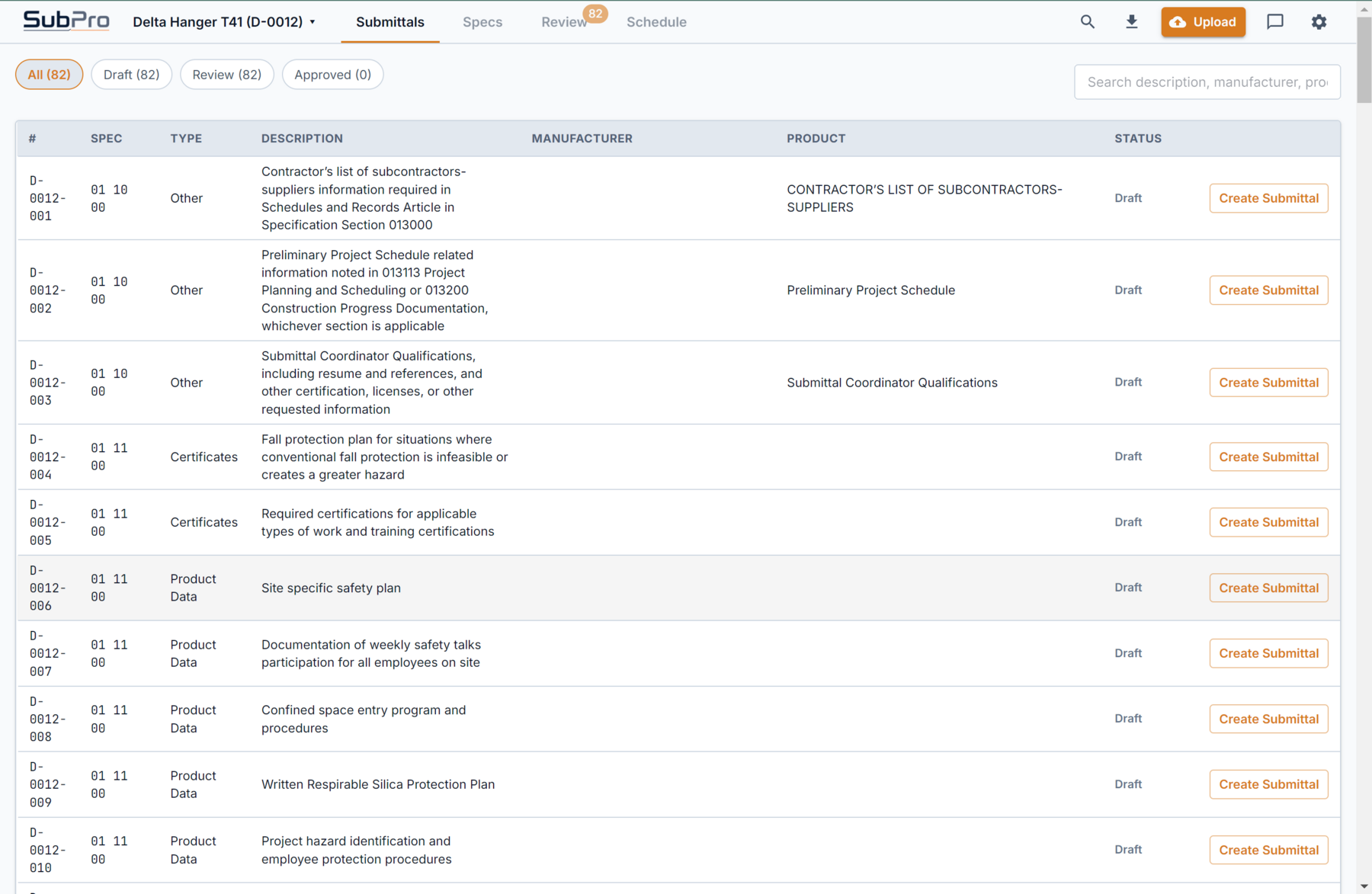
The submittal item or review obligation pulled from the project manual, named by type.
Section 09 51 00 Acoustical Ceilings, page 212: the reference that explains why the row belongs.
Who owes it, whether it has gone out, and what came back from the architect.
When procurement needs the stamp, and what was decided along the way.
Before a single product ships, the project manual spells out what has to be submitted and reviewed. Those requirements are spread across dozens of sections. The log gathers them into one set of obligations the whole team can see.
A log that is only a list of names does not help much. A useful row keeps its section, its type, its owner, and whether it still needs a decision. That is what lets a reviewer trust the list instead of re-reading the manual. Half the arguments over a log are two people using one word differently, and the glossary settles them.
The first draft matters most. It sets the starting scope for review, responsibility, and procurement, and a row missed there surfaces months later as material on a dock with no stamp behind it. To start one now, the free Excel template carries the same columns described here, with dropdowns and a filled example.
Manufacturer data for the acoustical panels, logged under 09 51 00 with the page it came from.
Product data for the grid and hangers, a separate row so the reviewer can confirm each component.
A samples row, flagged as an architect or owner selection, so the choice is not lost inside the list.
The required test report, tracked with a status so it is chased before install, not after.
A submittal log is the project list that tracks every required submittal, such as product data, shop drawings, samples, and test reports, along with the responsible party, review status, due dates, and notes. It turns requirements scattered across the project manual into one tracked set of obligations.
A useful row carries the requirement, its section, the submittal type, the responsible party, the source page, the review status, and a due date or note. The source page is what lets a reviewer confirm the row belongs.
Teams use the terms differently, and in practice both usually mean the organized list used to track required submittals and review progress. Some teams call the full source-backed list a register and a working slice of it a log.
Usually a project engineer, submittal coordinator, or document control lead. SubPro drafts the first version from the project manual so that person starts from real rows that show their pages.
Stop typing rows. This is the log building itself.
The log as software: editable, cited, and export-ready.
How teams review a drafted log without losing the evidence.
Upload a project manual and the Log Build returns the drafted log, a register, and a flagged-rows report.