SubPro
Example project Sample spec set
Get started
Construction submittal software

Construction submittal software that carries the record to closeout.

SubPro reads the specs and drafts the cited log, assembles the packages, then stays on the job: statuses move as reviews happen, revisions keep their history, transmittals log what went out, and closeout opens on a record instead of a reconstruction.
See the working record.

Everything SubPro builds sits in the open: the rows, the evidence behind them, the packages, and the statuses moving as the team works.

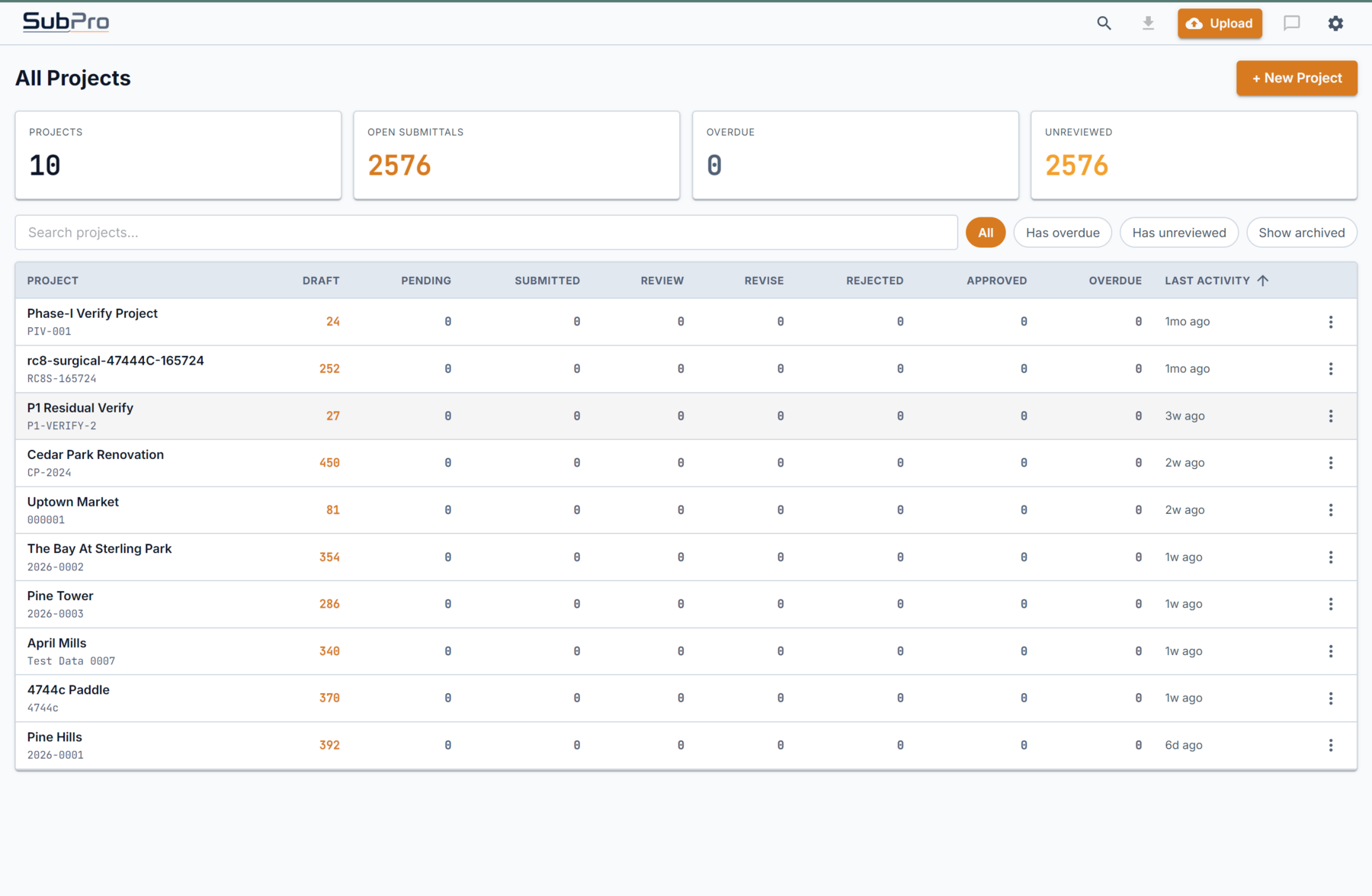
SubPro project dashboard with review status and project counts
Project visibility

See where every project stands: row counts, review progress, and package activity on one screen.

SubPro row actions for review approval source checks and package creation
Review actions in one place

Approvals, edits, source checks, schedule prep, and package creation stay connected to the row being reviewed.

Who runs on it

Give your workflow something worth tracking.

A record is only worth keeping if it starts complete and stays current. SubPro builds it from the spec book, keeps it moving through review, and holds the history the whole way. Different desks lean on different parts of that: the estimator wants the scope early, the PE wants the citations, document control wants the trail, and whoever owns closeout wants all three, in order, without asking anyone to remember anything.

General contractors

Use one project spec set to create a cleaner starting log before the team starts chasing responsible parties, dates, and approval routing.

Preconstruction teams

Spot major submittal obligations earlier, review scope sensitive items, and give operations a more useful handoff than a blank tracker.

Document control

Keep page references, review notes, and package support close to the handoff so cleanup is faster and the next reviewer is not starting over.

Closeout owners

Whoever inherits the last month inherits a record instead of a scavenger hunt: statuses final, revisions stacked, transmittal dates on file.

The time argument, briefly

The hours come back at both ends.

The front-end savings get the headlines: a reading-and-typing effort that consumed most of a working week arrives as a draft in hours. But the back end is where jobs actually bleed. Add up the where-are-we meetings, the which-rev-is-this emails, the closeout dig. On a spec-heavy job that is a second week, paid out in fifteen-minute installments nobody invoices. A record that answers questions itself returns those installments one at a time, all job long.

And when a question needs the manual rather than the log, the built-in chat takes it directly: ask, get the answer, get the page it lives on. Nobody re-reads Division 01 to settle a procedures argument. The document that used to be a wall becomes a witness you can cross-examine.

Where it fits

One record from the spec page to the closeout binder.

A construction submittal lives a long life: the specification defines it, somebody logs it, evidence gets assembled, reviews happen, revisions happen, it goes out, it comes back, and years later somebody needs to prove all of that happened in the right order. Most software picks one slice of that life. The result is a relay race where the baton is a spreadsheet, and every handoff drops context.

SubPro holds the whole thread. The log is born cited, straight from the spec pages. Packages attach to their rows instead of living in a folder named FINAL_v3. Statuses move as reviews actually happen, not when someone remembers to update a tracker. Revisions stack on the row with their history intact, so the current version and the story of how it got there are the same record. Transmittals log what left, when, and to whom.

No stage of that requires re-entering what a previous stage knew. That is the whole trick. Every handoff between tools is a chance for the record to lie, and SubPro's answer is to remove the handoffs, not to referee them.

The month-three problem

Tracking spreadsheets die young. The record should not.

Here is the lifecycle nobody puts on a brochure. Week one: a beautiful tracking spreadsheet, color-coded, current. Month three: the PE who owned it got pulled to another job, four rows say "see email," and the color code has forked into two competing dialects. Month nine: the project runs on tribal knowledge and the spreadsheet is opened only to be apologized for.

Then the job ends, and the real bill arrives. Closeout asks simple questions: was the fire-stopping product data approved, which revision of the pump submittal is final, when did the keying schedule go to the owner. Answering them from a dead spreadsheet and a shared inbox is a two-week archaeology project someone runs while also trying to demobilize. Every contractor has paid this bill. Most have just stopped itemizing it.

The record dies for one reason: keeping it alive was always somebody's second job. Any system that depends on a busy human doing bonus data entry loses to month three. The fix is not discipline. Construction has plenty of disciplined people, and their spreadsheets die anyway, because a jobsite reprioritizes ruthlessly and the log never wins a fight against a concrete pour. The fix is a record that updates because the work went through it, so there is no fight to lose.

Pillar: the record

Closeout is a query, not a project.

Because the submittal record accumulates where the work happens, the questions that used to take weeks become lookups. What is outstanding? Filter by status. What changed after addendum two? Open the revision history. What did we send the architect in March? The transmittal record has the date, the contents, and the recipient. Nobody reconstructs anything, because nothing was ever lost.

Three kinds of history ride on every submittal. Status history: drafted, reviewed, sent, returned, resolved, with the log answering for each row. Revision history: when the spec moved, the row moved with it, and the previous state is still there, not overwritten. Transmittal history: the outbound record of every send. Together they are the answer to the only closeout question that matters: can you prove it.

Run the scenario that actually happens. Eighteen months after substantial completion, a cabinet door delaminates and the owner's rep asks whether the installed product matched the approved submittal. On most jobs that question triggers a search party. Here it is a lookup: the row shows the approved revision, the transmittal that carried it, the date it cleared, and the spec page that required it. The answer takes four clicks and none of them are in an email archive.

The honest part: SubPro is not a closeout binder generator, and the approval judgment stays with your PM, PE, and the design professionals. What it guarantees is that when a person sits down to close the job out, the record they need already exists, cited, dated, and in order. The work of closeout becomes reading, not excavating.

The span, stage by stage

What the record looks like at each point in the job.

Day one. The spec book goes in. What comes back is a log: every required submittal as a row, grouped by division, each carrying the page it was read from. Nothing has been typed. The team's first contact with the log is reviewing it, which means the submittal effort starts with its scope actually known, a luxury most jobs never get.

The review weeks. Rows get confirmed, reassigned, and argued about, which is the job working as intended. Flags mark where a substitution is allowed or an owner decision is pending. As packages assemble, the evidence lands on the row it belongs to. Statuses record each call as it is made, so "where are we" always has a current answer nobody had to compile.

The long middle. Submittals go out under dated transmittals. Reviews come back. An addendum rewrites two sections and the affected rows revise in place, history intact. People rotate on and off the job and the record does not care, because none of it lives in anyone's head or inbox. This is the stretch where hand-kept logs quietly die, and where a record that maintains itself simply does not.

The last month. Closeout requests arrive and the answers already exist. Final statuses, approved revisions, transmittal dates, the citation trail back to the spec. What used to be a reconstruction project is an export. The job ends with the record it deserved, and the next job starts with the team that built it still speaking to each other.

Worked example

One mechanical section through the front stage.

Take Division 23 00 00 Mechanical, HVAC, where the submittal list runs long across equipment, distribution, and controls, and where three trades will eventually argue about who owed the coordination drawings. Here is the front of that section's life.

Equipment data

Rows for air handlers, pumps, and terminal units, each tied to its 23-section reference and source page.

Coordination drawings

A row for required mechanical coordination and shop drawings, flagged where trades overlap and a decision is needed.

Controls submittals

Rows for the building controls and sequence-of-operations submittals, kept distinct so each is reviewed on its own.

Handoff to tracking

The reviewed 23-division set exports as a source-backed register, ready to load into your approval and tracking workflow.

Second example

A small section's whole life.

Big divisions show scale. Section 10 44 00, Fire Protection Specialties, shows the lifecycle instead: a handful of extinguishers and cabinets, maybe a dozen rows total, that still manage to generate paperwork for a year and a fire marshal question two years after that.

Born cited

Rows for extinguisher product data and cabinet shop drawings, each pointing at the 10 44 00 page that demands it.

Reviewed and revised

The architect kicks back the cabinet finish. The revision lands on the row, and the first submission stays in its history instead of vanishing.

Sent, on the record

The resubmission goes out under a transmittal with the date and contents logged, which settles the who-sent-what argument before it starts.

Closed without digging

At closeout, the row reads start to finish: required, submitted, revised, approved. The fire marshal's question takes one click, not one afternoon.

Pushback, taken seriously

The objections that come up on every call.

"The GC makes us use their platform anyway." Then use it. Nothing about a mandated portal requires you to show up to it empty-handed. SubPro is where your side of the work gets done: the cited log, the assembled packages, your statuses and history. The editable XLSX and PDF exports drop into whatever the GC runs, and you keep a record you own after the job ends and their portal access disappears. The subcontractor who keeps their own books is never sorry.

"We do not need another system to update." Agreed, and this is the test that kills most software: does the record demand extra work to stay true? Here, status moves because a reviewer clicked approve, history exists because a revision was uploaded, the transmittal logged itself when the package went out. The maintenance is a side effect of doing the job. If your team stops touching submittals entirely, the record goes stale, and if that happens you have larger problems than software.

"AI reading our specs makes people nervous." Reasonable nerves. Two facts usually settle them: every extracted row carries the spec page it came from, so nothing asks to be believed without evidence, and the spec book itself is deleted after the run, never retained, never used for training. The rest of the detail lives on the data handling page, in the same plain language.

"We are too small for this." Small teams have it worst. A fifty-person GC has a document controller; a nine-person specialty contractor has a PM doing submittals at night. The smaller the team, the more of its total hours the paperwork eats, and the more one missed requirement hurts. Pilots start with one spec set precisely so a small shop can see the value on one real job before committing to anything.

Construction submittal software FAQ

Where does SubPro fit in the construction submittal process?

The whole span. It reads the specifications and drafts the cited log, assembles the packages, then keeps working: statuses move as reviews happen, revisions stack with history, transmittals record what went out, and closeout opens on a complete record.

Do I still need my submittal tracking tool?

Only if a GC requires one. SubPro tracks the submittals it builds: status, revision history, and the transmittal record per item. Where a mandated platform exists, the XLSX and PDF exports drop your record in without a retyping project.

Does SubPro manage approvals or closeout?

It keeps the record for both. Your PM, PE, and design professionals still make the approval calls. What SubPro contributes is the paper trail those calls sit on: what was submitted, revised, sent, and returned, ready when closeout asks.

Can contractors start with one project?

Yes. Pilots start with a fit call and one spec set so the team can review output quality, timing, and data handling needs on a real job before anything scales beyond it.

How do revisions show up on a submittal?

As layers, not replacements. A revised item shows its current state on top and every prior submission underneath, each dated. The question "what did rev one say" has an answer on the row, not in an inbox.

Can we start on a job that is already underway?

Yes. Run the spec set whenever you arrive. The cited draft becomes a baseline to reconcile against whatever log exists, which is usually the fastest audit that log has ever had.

What does closeout actually look like?

Mostly reading. The record is already assembled: every submittal with its full status trail, its revision stack, and its transmittal dates. Export it, attach it, done. The two-week reconstruction is the part that simply disappears.

Is this for specialty contractors or GCs?

Both use it, differently. Specialty contractors run their own scope and keep a record the GC's portal cannot take away from them. GC-side teams use it to build and verify the project-wide starting set and keep the master record honest.

Start the record

The record has to start somewhere.

Before status and closeout comes a first draft. A Log Build gets a project from spec book to reviewable rows.

Related SubPro pages

The pages around this one, from the first pass to the files you get at the end.