Source-backed draft
Every row comes from the project manual and carries its page, so a reviewer traces the basis before the register moves on.
 Book a fit call
A source-backed register is useful only if the team can see where each row came from. SubPro drafts the first pass, keeps the spec page on every row, and exports a register your team can inspect.
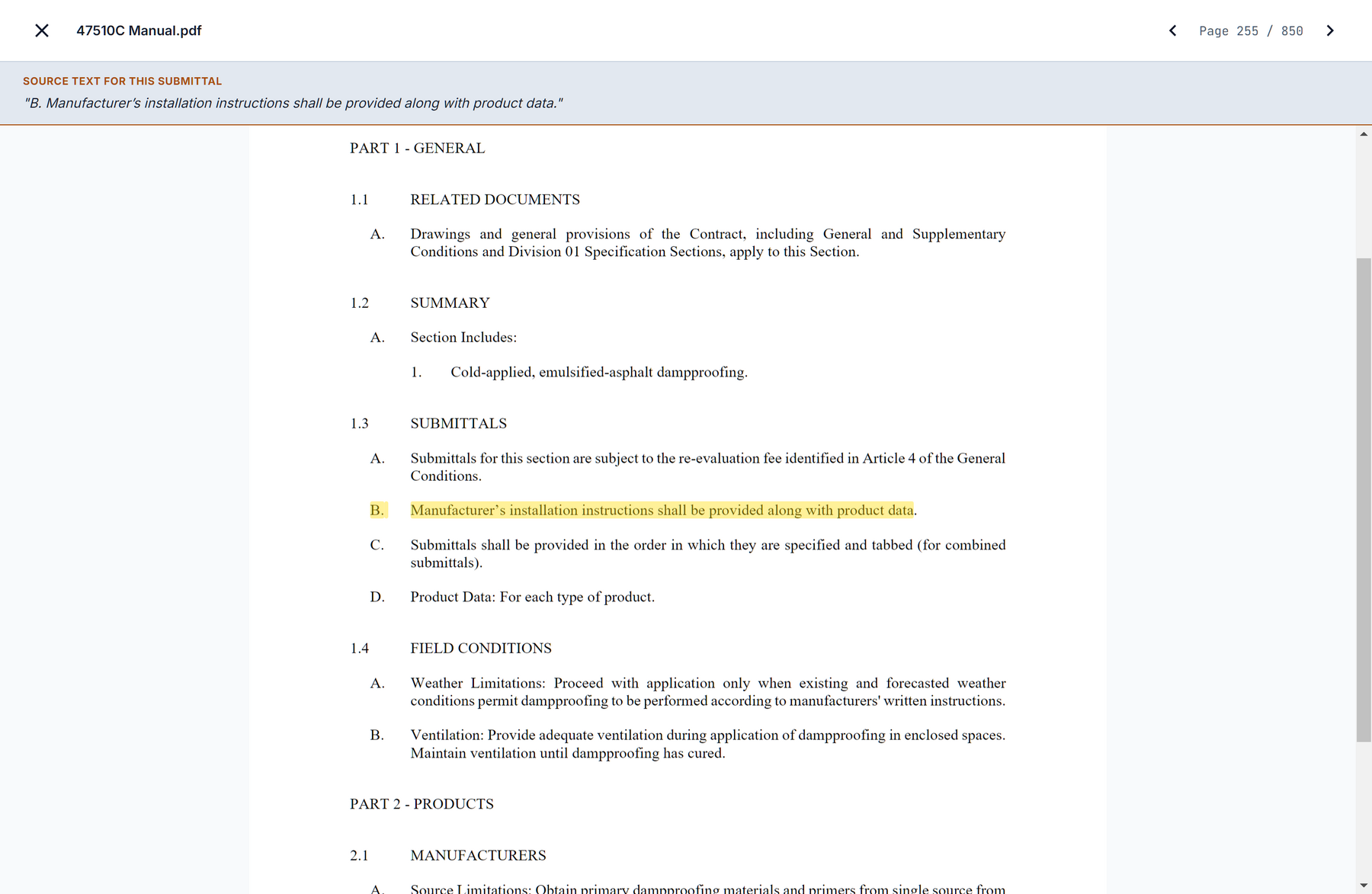
Every row comes from the project manual and carries its page, so a reviewer traces the basis before the register moves on.
Anything that needs clarification or a PM's decision is marked before the team treats the register as complete.
Once the rows are inspected, the register exports to a spreadsheet and feeds the downstream schedule.
| Submittal register | Submittal log | |
|---|---|---|
| What it is | The full source-backed list of every obligation the project manual imposes. | The working view used to track status day to day. |
| When it is built | First, from the spec book, before anything is tracked. | On top of the register, as rows go out and come back. |
| What goes wrong | A requirement skipped here never surfaces in tracking. | Statuses drift when updating them is somebody's second job. |
| What SubPro builds | This one, with the page behind every row. | The same rows, carried forward with status and history. |
Section 05 12 00 Structural Steel: a row for the shop drawings, carrying the section and the exact page behind it.
A row for the required mill test certificates, source-linked so a reviewer confirms the requirement without the book.
Rows for welder qualifications and procedures, flagged where a decision or clarification is needed.
Every 05 12 00 row lands with its evidence attached, so the team can defend it in coordination.
A register is only as good as its worst row. The first time a line turns out to be somebody's guess, reviewers quietly stop trusting all of them. Because every SubPro row carries its citation, the worst row on the sheet is still a checkable one, and the register survives its first mistake with its credibility intact.
SubPro builds the register before the log because that is the riskier part. Skip an obligation at the register stage and no amount of tracking will surface it.
A tool reads the project manual and builds the first-pass register, so the team reviews instead of transcribes. SubPro keeps the source evidence behind each row and hands off an editable file.
The terms overlap and many teams use them interchangeably. When distinguished, the register is the fuller source-backed list of every obligation pulled from the spec book, and the log is the working view used to track status. SubPro builds the register first.
A register is only as trustworthy as the team's ability to check it. Keeping the source page behind each row lets a reviewer confirm why a requirement is listed and catch anything missing, instead of accepting a list on faith.
No. It is a reviewable starting point. The project team verifies scope, substitutions, responsible parties, dates, and final requirements before it moves into tracking.
Every Log Build ships the register view beside the log: which sections demand submittals, how many, and the page for each.
The reading pass that populates the register in the first place.
Registers feed the record: status, history, and closeout in one place.
What the finished register exports look like on disk.
One project manual in, one cited register out. Open any row to its page and judge the evidence before you commit.