
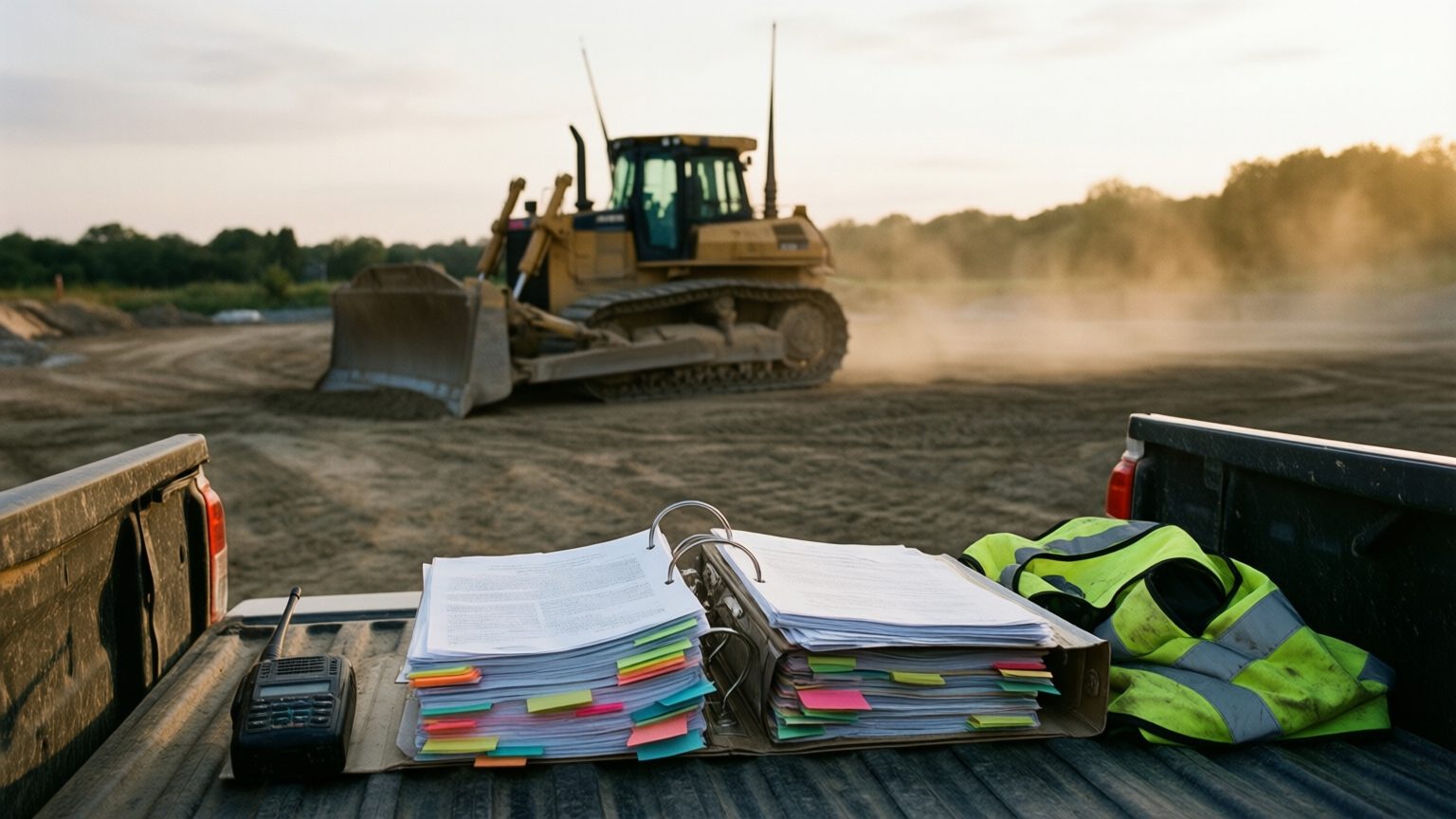
Somewhere around 1995, a surveyor stopped writing numbers in a field book and started pushing a button. Somewhere around 2005, a dozer started steering itself. Somewhere around 2015, a robot laid brick on a real wall for money.
And somewhere around right now, a project engineer is retyping a number out of a PDF into a spreadsheet cell, by hand, for the four hundredth time this month.
That gap is the actual story of construction automation. Not that it failed. It worked, spectacularly, in one direction and barely at all in another. The closer a task sits to dirt, steel, and concrete, the more automated it got. The closer it sits to paper, the less.
The 1990s: the drawing leaves the board
The decade opened with drafting tables still in use and closed with almost none. CAD had existed since the seventies, but the nineties are when it stopped being a mainframe curiosity and became the thing every architect and engineer actually drew on.
The field got its own version. Total stations replaced the transit and the chain. Layout that took two people and a day started taking one person and an afternoon. Laser screeds arrived and concrete flatness went from a craft to a spec you could hit repeatably.
Scheduling went digital too, and this is where the first honest warning sign shows up. Software made the schedule easier to draw. It did not make anyone better at building to it. A CPM schedule with four thousand activities is not a plan, it is a very confident drawing of one.
The 2000s: the model, and the machine that drives itself
Two things happened in this decade that still define the industry.
The first was the model. Revit shipped in 2000 and Autodesk bought it in 2002, and over the following years "BIM" went from a vendor word to a contract requirement. Clash detection turned a coordination meeting from an argument into a screenshot. That is a genuine, measurable win, and it is worth saying plainly because most of this decade's promises were not.
The second was GPS machine control. A grader that knows where the finished surface is does not need stakes, and it does not need a grade checker walking in front of it. Earthwork got faster, more accurate, and less dependent on the one guy who could read the plan. This is the single most complete automation success in the industry's history and almost nobody outside heavy civil talks about it.
Meanwhile, the paperwork moved onto the internet and stayed exactly as much work. Web-based document management arrived. Procore was founded in 2002. Bluebeam gave everyone PDF markup. The RFI log went from a binder to a spreadsheet attached to an email, which is a change of medium, not a change of method.
The 2010s: the jobsite gets a camera and a robot
This was the decade of the pilot project.
Drones went from novelty to standard practice for site survey and progress documentation, and that one actually stuck. Laser scanning got cheap enough to use on a renovation instead of just a refinery. Reality capture companies figured out that a 360 camera on a hard hat beats a report.
The robots were louder and less conclusive. A semi-automated mason laid brick faster than a person on long straight runs and was useless on anything else. Autonomous excavation companies raised real money and got real machines onto real dirt, in narrow applications. Concrete 3D printing produced houses that got a lot of press and did not change how houses get built.
Layout robots deserve a mention because they are the quiet win of the decade. A machine that prints the wall lines on the slab from the model removes a whole category of human error at the exact point where errors get expensive.
The decade also produced its cautionary tale. Katerra raised well over a billion dollars to industrialize construction end to end and went bankrupt in 2021. The lesson people drew was that construction resists automation. The more useful lesson is that it resists automation applied from the outside by people who have not done the work.
Autodesk bought PlanGrid for about $875 million in 2018. Drawings on an iPad, which is to say a better way to look at a document, was worth nearly a billion dollars. Hold that thought.
The 2020s: the machines can read
Everything before this could see, move, or measure. The current wave can read, and that is a different capability aimed at a different problem.
Computer vision started tracking progress against the model without anyone filling in a percentage. Language models started doing something more interesting: they can read a document and answer a question about it. Not perfectly. Not without review. But a machine that can take a forty-page spec section and tell you what is in it is a thing that did not exist in 2019.
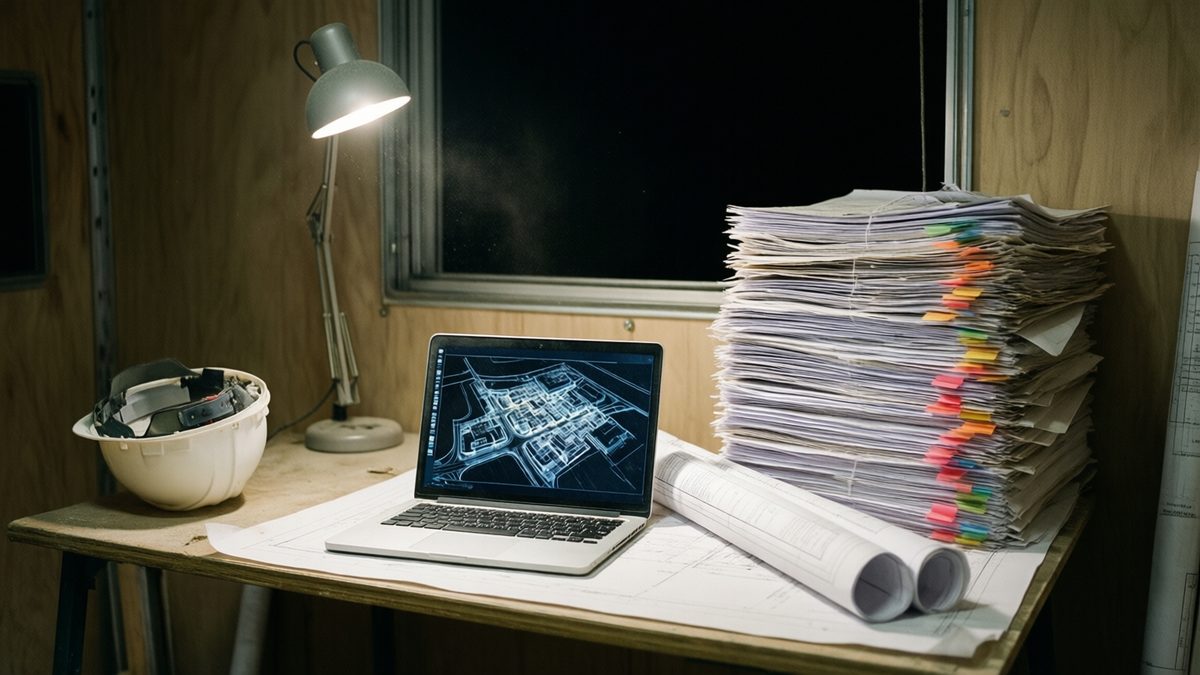
This matters because it is the first automation wave pointed at the paperwork instead of the work.
What never got automated
Look at what an automated jobsite in 2026 actually looks like. The dozer knows the grade. The layout is printed on the slab. The drone flew the site this morning and the model updated itself. The concrete came from a batch plant that adjusted the mix on the way over.
Now walk into the trailer.
Somebody is retyping numbers out of a PDF into a spreadsheet. Somebody is reconciling two versions of a schedule by eye. Somebody is reading back through an email thread to work out what got decided three weeks ago, because the decision lives in that thread and nowhere else. The estimator is checking a takeoff against a drawing by looking at both and counting.
None of that is hard the way grade control is hard. Grade control needed satellites, a control box, and a machine that could act on a centimeter. The trailer work needed somebody to care about it, and for thirty-five years nobody did, for two reasons worth naming out loud.
The first is that automation follows the demo. A machine that steers itself is a thirty second video that sells a machine. A robot laying brick is a news segment. A person spending Thursday afternoon retyping a table is not a video, it is a Thursday afternoon, and it has never once made anybody's keynote.
The second is that it is nobody's territory. Trailer work sits in the gap between the design team's software and the field team's software, and anything living between two systems belongs to neither. Both vendors can point at it and say it is the other one's job. Both are right. It stays manual another decade.
Now remember PlanGrid. Autodesk paid roughly $875 million for a better way to look at a document. Not to write one, not to reconcile two of them, not to answer a question out of one. Just to look at it on an iPad. That number is the industry telling on itself about how much of this job is documents, and how little of that anyone had bothered to automate.
Which is why the current wave is more interesting than the robot videos. Reading is the first capability aimed squarely at the half of the job that never got a machine. Whether it survives a real project is a separate question, and it is the one worth asking every time somebody demos something.
Thirty-five years of automation went to the parts of the job you can photograph.
That is the beat this publication is going to cover: the tools, who they actually help, and whether the claim survives contact with a real project. Some of them are very good. Some of them are a spreadsheet with a login.